From Motivation to Capacity: Integrating CBT and Lifestyle Medicine in Menopause Care
19th Oct, 2026

As Lifestyle Medicine practitioners, we know and understand the importance of behaviour change in overcoming health challenges and supporting long-term health and wellbeing. Yet translating knowledge and motivation into sustainable action and turning these actions into habits remains an all-too-familiar clinical challenge.
We have all come across individuals who understand the benefits of improving their sleep, exercise, healthy eating and stress management but are unable to translate their motivation into sustainable action. When we come across this paradox in clinical practice, we usually try to make sense of it through the lens of motivation, readiness and confidence to change. In my clinical practice, I have come to recognise that there might be another dimension which, when taken into consideration, might give us a more comprehensive understanding of the barriers our patients face when engaging in behavioural changes they are motivated to make but unable to implement. This often-overlooked dimension is the capacity to change.
Menopause can be a good example that illustrates this concept of increased pressures and dwindling resources. Many women find themselves at this stage of life caught between conflicting demands, often looking after two generations (children and ageing parents), managing work pressures and relationships, while navigating the challenges of the physical and psychological changes induced by hormonal fluctuations during perimenopause. For a good proportion of women, fluctuating hormones, disrupted sleep, vasomotor symptoms, fatigue, cognitive difficulties and changes in emotional regulation can create a context that places an increased burden on their limited resources (1).
Additionally, for other women, financial insecurity, inflexible working conditions, unequal caring responsibilities and limited access to healthcare or supportive environments further constrain their options. These are not just individual barriers to overcome, but wider social determinants of health that shape which changes are realistically achievable for women (2).
Within this context, many women might well understand the benefits of exercise, healthy eating and stress management. They might want to make changes but struggle to implement them. The interacting demands of their life circumstances and hormonal landscape can affect the resources available for everyday functioning, leaving little in reserve for developing and embedding new behaviours.
So, what might look like poor motivation or adherence might, in fact, be a mismatch between the demands of change and the resources currently available to meet them.
And this point illustrates that motivation and capacity to change are not interchangeable. A woman may be highly motivated but struggle to find the resources needed to translate intention into action. This perspective is aligned with the COM-B model (3), which recognises that behaviours are the result of the interaction of capability, opportunity and motivation. Capacity to Change is a complementary clinical lens which attempts to describe the interaction between the resources available and the demands under which an individual operates when attempting to engage in behavioural change. These resources are physiological, cognitive, emotional and contextual, and they fluctuate depending on health, sleep, stress, competing responsibilities and life circumstances.
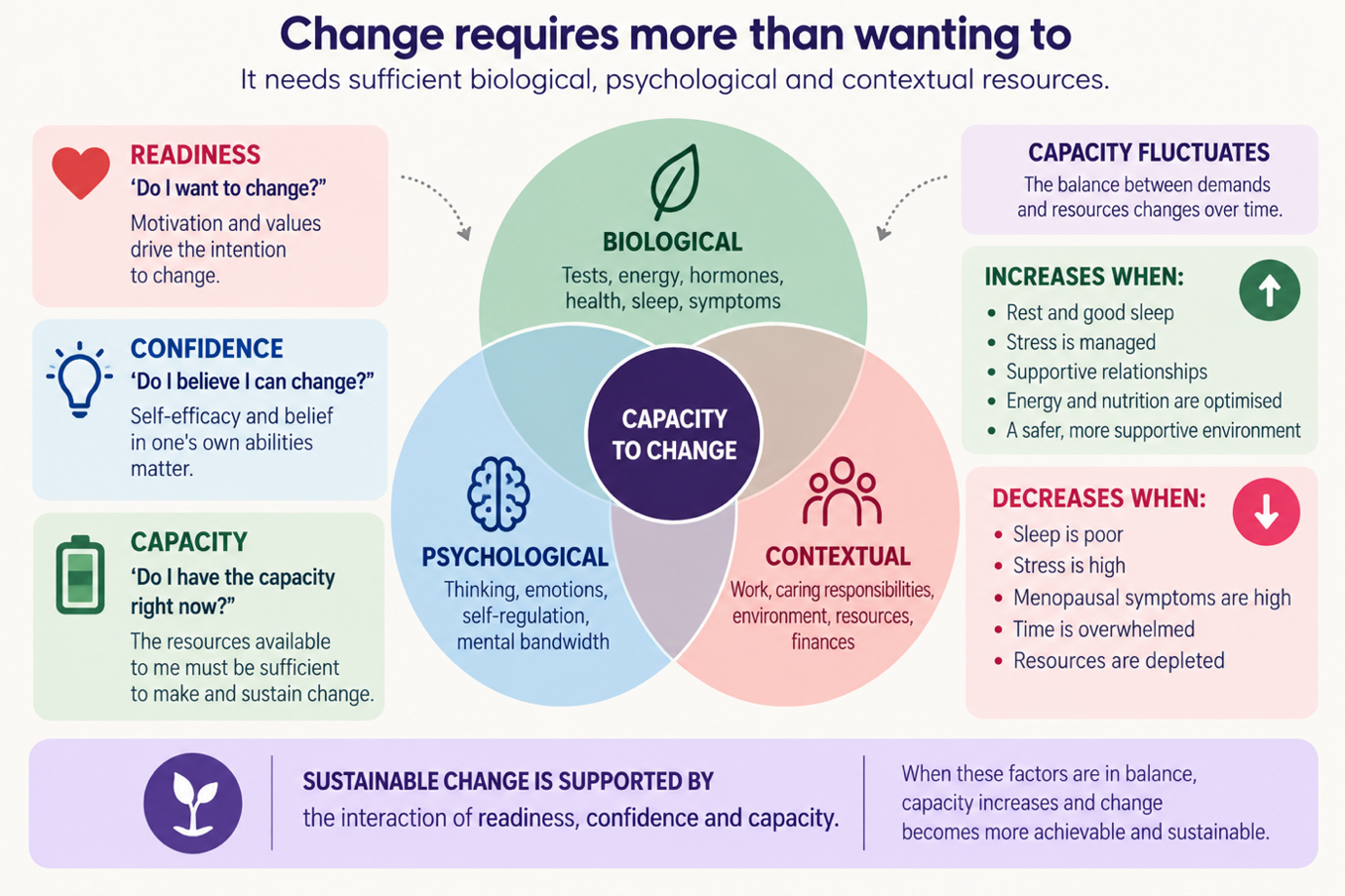
One way I help my clients understand this is through the Body Energy Budget metaphor, conveying the concept that the energy we have is the body’s currency. In the same way that we manage our finances, balancing expenditure with income, we need to think about managing our body’s energy in relation to the available physical, emotional, cognitive and contextual resources.
Everyday activities, emotional demands, physiological stressors and cognitive effort use our energy, reducing our available resources. On the other hand, sleep, rest, supportive relationships and effective coping strategies may help restore our energy.
When demands repeatedly exceed available resources, implementing new behavioural changes might prove challenging, even when the person understands the benefits of making these changes.
This concept of capacity should be understood as a dynamic resource, rather than a personality characteristic, which fluctuates with symptom burden, sleep, stress, competing responsibilities and environmental support.
When we recognise this dimension, our clinical understanding shifts from asking the question, “Why is this person ‘resistant’ or not ready to change?” to “What is limiting this person’s capacity at this time?”
This is where I believe menopause-informed Cognitive Behavioural Therapy (CBT) and Lifestyle Medicine can be great partners and offer valuable integration (4,5).
Lifestyle Medicine provides an evidence-informed framework for identifying behaviours that support health, including sleep, physical activity, nutrition, stress management, social connection and reducing exposure to harmful substances such as alcohol and tobacco. CBT offers a framework for understanding the psychological and behavioural processes influencing their implementation.
But here I must clarify a point: CBT is not simply about challenging negative thoughts. By developing a shared understanding with the client,
CBT explores how physiological arousal, beliefs, emotions, coping strategies and behavioural patterns interact with an individual’s biological and environmental circumstances.
Consider a woman who is struggling with disrupted sleep, which contributes to fatigue and reduced concentration. Concerned about her performance, she works longer hours, drinks more coffee and spends less time doing things that help restore her energy and capacity. This leads to increased arousal, which may further disrupt her sleep. Her coping strategies are understandable, but some may unwittingly create a vicious cycle that maintains her difficulties and reduces her capacity.
A menopause-informed CBT formulation helps identify these maintaining cycles and opportunities to break unhelpful patterns, improve regulation and support adaptive coping, while recognising that the biological and contextual contributors cannot simply be addressed through cognitive or behavioural techniques alone.
On the other hand, lifestyle interventions can help build up the physiological and psychological resources needed for change.
But here is an interesting paradox: the very behaviours that can help restore capacity often require capacity to implement.
In clinical practice, this has implications for how we choose, adapt and sequence interventions.
Rather than introducing multiple lifestyle recommendations early in our intervention, we might begin by exploring three questions:
• What is currently sapping the greatest proportion of this person’s available capacity?
• Which physiological, psychological or contextual factors could be addressed to reduce that burden?
• What meaningful change is achievable within their current capacity, while potentially helping to expand it?
For some women, addressing sleep disruption or reducing unnecessary demands may be the most appropriate starting point. For others, a manageable increase in physical activity, behavioural activation or reconnecting with supportive relationships may itself begin to build capacity. This process is not linear, as capacity enables behaviour change, but appropriately supported behaviour change can also increase capacity.
And here I must be very clear – capacity does not replace established concepts of motivation, capability, opportunity or self-efficacy. Rather, it offers an additional clinical lens through which to understand their interaction in everyday life.
For women navigating menopause, integrating CBT and Lifestyle Medicine provides an opportunity to move beyond well-intentioned but often oversimplified advice to ‘meditate, reduce stress, eat less and move more’, towards more individualised and appropriately sequenced interventions.
Perhaps the most useful question we can ask when working with women navigating the menopausal transition is not simply, “What does this person need to do differently?” but “What needs to change for this person to be able to do things differently?”
That shift, from prescribing change to enabling change, may be central to making Lifestyle Medicine interventions more accessible, compassionate and sustainable.
1. Thurston, R. C., Thomas, H. N., Castle, A. J., & Gibson, C. J. (2025). Menopause as a biological and psychological transition. Nature Reviews Psychology, 4, 530–543. https://doi.org/10.1038/s44159-025-00463-9
2. World Health Organization. (2025). World report on social determinants of health equity. https://www.who.int/publications/i/item/9789240107588
3. Michie, S., van Stralen, M. M., & West, R. (2011). The behaviour change wheel: A new method for characterising and designing behaviour change interventions. Implementation Science, 6, Article 42. https://doi.org/10.1186/1748-5908-6-42
4. Khadilkar, S., Divakar, H., Benedetto, C., Genazzani, A., Ramos, D., Argale, E., Deshpande, G., Hicky, M., Da Silva Filho, A. L., Herrera, E., & Balkrishnan, M. (2026). FIGO best practice recommendations for the mental health of women at menopausal age. International Journal of Gynecology & Obstetrics, 173(2), 588–601. https://doi.org/10.1002/ijgo.70943
5. Rukure, H., & Husted, M. (2026). Cognitive behavioural therapy for menopausal symptoms: A systematic review of efficacy in improving quality of life. BMC Women’s Health, 26, Article 58. https://doi.org/10.1186/s12905-025-04142-y
More BSLM News: